
Have you ever held a handmade ceramic bowl and felt an inexplicable warmth? Or run your fingers across a hand-carved wooden spoon and sensed the presence of its creator? That feeling isn't magic. It's a profound psychological and sensory phenomenon that reveals why handmade objects resonate so deeply in our automated world.
The Soulful Imprint: More Than Just "Made by Hand"
When we talk about handmade objects, we're not simply describing production methods. We're encountering what can only be called a "soulful imprint," the tangible evidence of human care, thought, and intention embedded within an object. This connection emerges from the intersection of physical traces, psychological responses, and cultural meaning.
In an era dominated by digital precision and mass production, handmade pieces serve as a psychological antidote to sterile perfection. They carry markers of human ingenuity, identity, and resilience that technology, despite its flawless execution, simply cannot replicate.
Reading Objects Through Touch: The Haptic Connection
We don't just look at handmade objects. We read them through an imagined or actual sense of touch. This "haptic gaze" creates a primary channel for connection.
Consider how a ceramicist might deliberately leave throwing rings inside a pot. This isn't carelessness; it's communication. These subtle ridges allow you to feel the rhythm of the wheel, the pace of studio work, and the movement of hands shaping wet clay. Each texture tells a story:
- Throwing rings in pottery convey the rotation and pressure of creation
- Irregularities in naturally dyed fabric reveal the unpredictable beauty of plant-based colors
- Hand-carved details in furniture document the maker's deliberate choices at every stroke
These aren't errors. They're a language. Through texture, makers pass on the feeling of their materials and processes, creating what researchers call "sensorial empathy." When you hold that textured bowl, you're not just touching clay; you're connecting with the physical experience of its making.
The Psychology of Touch Deprivation
The COVID-19 pandemic revealed something profound about our need for tactile connection. During lockdowns, people rediscovered craft in unprecedented numbers. Why? Touch-starved individuals found that the sensual pleasure of working with materials—the thrill of shaving wood or twisting yarn—could partially replace the gratification of human contact.
Our brains are hardwired to associate affectionate touch with stress relief and comfort. Engaging with tactile craft objects triggers similar psychological responses. The handmade bowl becomes a proxy for the maker's hand; by holding it, you're subconsciously "shaking hands" with its creator.
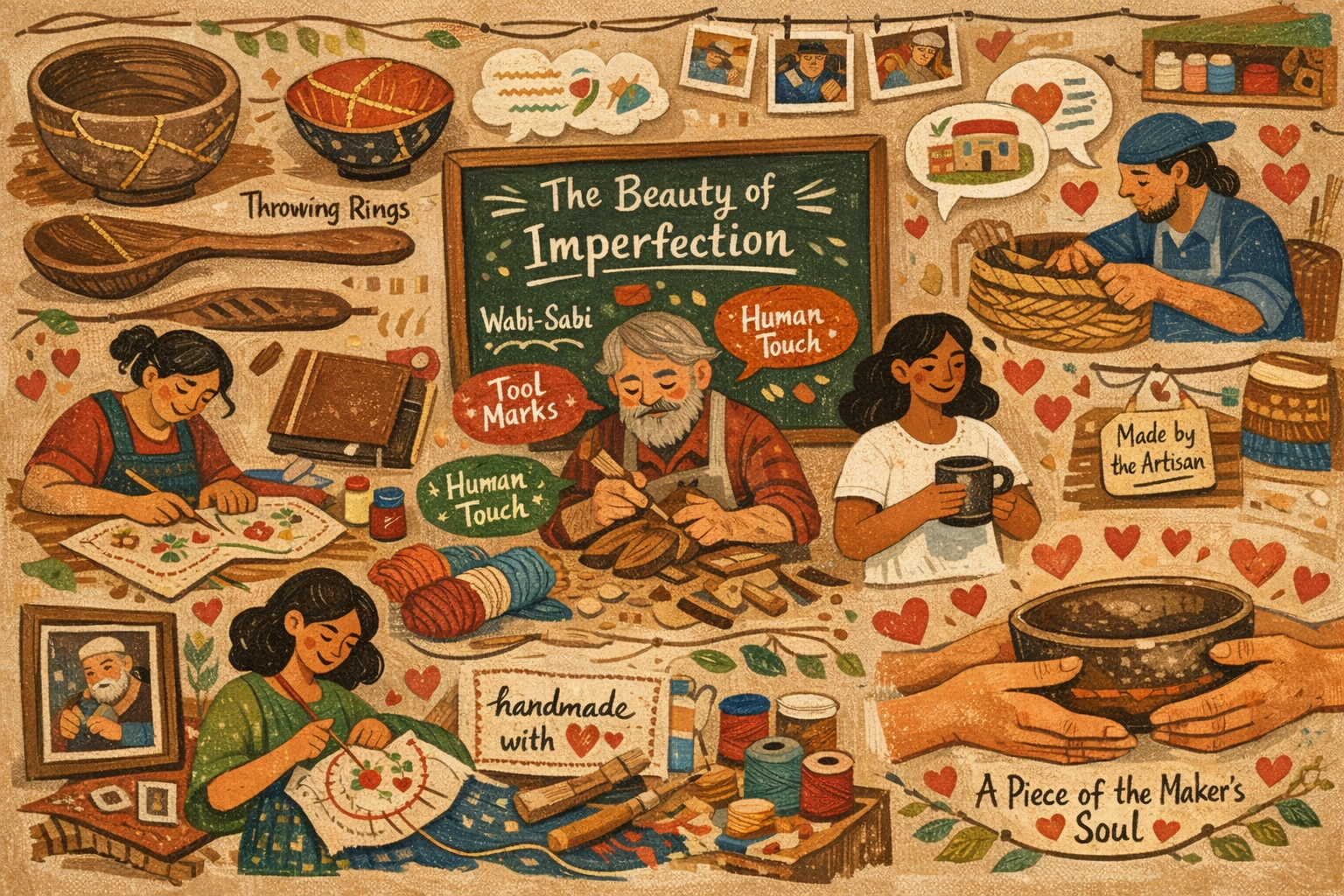
The Beauty of Imperfection: Why Flaws Create Connection
Here's a paradox: the value of handmade objects often lies not in their perfection, but in their imperfections.
Mass-produced items and AI-generated designs can replicate patterns flawlessly. But this precision feels cold and soulless. Meanwhile, the slight asymmetry in a hand-thrown mug or the variation in hand-stitched embroidery adds character and humanity.
The Philosophy of Wabi-Sabi
The Japanese concept of wabi-sabi provides the most eloquent framework for understanding this. It celebrates beauty that is imperfect, impermanent, and incomplete—embracing asymmetry, roughness, and natural aging as essential qualities.
Consider kintsugi, the art of mending broken pottery with gold. Instead of hiding cracks, this practice celebrates them, transforming damage into highlights of beauty and history. The repaired bowl becomes more valuable, not despite its brokenness, but because of it.
This philosophy mirrors our own experience. We connect with imperfect objects because they reflect the imperfect, yet beautiful, nature of our own lives. A "perfect" object is a closed system with no story. An "imperfect" object invites us to imagine its creation, to complete its narrative, and thus to forge a connection.
Tool Marks: Signature or Flaw?
The most direct evidence of a maker's hand is visible tool marks—the light chisel marks on wood, the texture left by carving tools, or the subtle variations in hand-stitched seams. But within craft communities, there's a fascinating debate about these marks.
Some view tool marks as essential proof of handwork. One gallery manager famously rejected a perfectly finished handmade ring because it showed no tool marks. For this buyer, those marks were the primary signifier of human labor and intrinsic value.
Others argue that achieving a flawless, hand-rubbed finish represents the true hallmark of craftsmanship. Master carver Janel frames it perfectly: "Do the tool marks enhance the intent of the piece, or do they detract from it?"
Both approaches create connection—one through visible evidence of process, the other through the invisible evidence of obsessive dedication. What matters is the conscious choice behind the decision, revealing the maker's philosophy and intent.
The "Handmade Effect": Why We're Wired to Prefer Handcrafted Goods
Research has identified a powerful psychological bias: we consistently find handmade products more attractive than identical machine-made ones. This "handmade effect" is driven by two key mechanisms.
The first is what researchers call the "love account." We perceive that handmade products symbolically "contain love." This isn't literal. It's a symbolic transference where we sense the maker's emotional investment, passion, and care embedded in the object. As one study noted, "machines just do not produce love." This is why handmade gifts create deeper connections and why artisanal products are perceived as more sincere and authentic.
The second mechanism is the "effort heuristic." Our brains judge value based on perceived effort. Social psychologists call this our "recognition of the sweat that went into making." Studies show people value paintings, poems, and objects more highly when they believe more human effort was invested.
One experiment revealed that a painting described as taking 26 hours was judged higher quality than an identical one supposedly taking four hours. We're hardwired to infer significance from human effort, and brain scans confirm it—showing greater activation in pleasure centers when viewing human-generated versus computer-generated artwork.
In our age of automation, human effort has become the new luxury. We're not just consuming objects; we're consuming the humanity of makers.
The Maker's Journey Becomes the Object's Soul
To truly understand the connection, we must consider the maker's experience, because that experience becomes physically embedded in the object.
The hands-on nature of craft induces states of mindfulness and flow, serving as an emotional outlet for artisans. But more profoundly, craft is a negotiation between maker and material. Clay, wood, and fiber aren't passive substances to be dominated; they're active partners with their own "personalities."
A ceramicist responds to clay's plasticity. A woodworker works with the grain. A weaver negotiates with fiber's elasticity. The final object is the physical artifact of this dialogue—not human dominating material (the industrial model), but human collaborating with it.
This "material agency" is precisely what makes handmade objects feel grounded and alive. We sense not just human presence, but a human who is connected to the physical, natural world. In our digital, abstract age, this physical dialogue is a radical act of grounding.
Historical Roots: Why We Value the Human Hand
The values we've explored—authenticity, imperfection, the "soul" of craft—aren't timeless. They were forged as a reaction to industrialization.
In the late 1800s, the Arts and Crafts Movement emerged as philosopher John Ruskin argued that industrial production was dehumanizing, creating an alienating distance between designer and manufacturer. His defining belief: "Fine art is that in which the hand, the head, and the heart of man go together." William Morris, the movement's practitioner, advocated returning to craftsmanship and honesty of materials as a way to improve not just objects, but society itself.
In 1920s Japan, philosopher Sōetsu Yanagi created the Mingei ("folk art") movement as Japan rapidly modernized. He celebrated the unknown craftsman whose work was anonymous, functional, and deeply tied to nature and tradition.
These movements gave us the vocabulary—honesty, integrity, soul, humanity—to value the very qualities that industrialization sought to eliminate. When you feel connected to a handmade object, you're participating in this 150-year philosophical conversation.
The Power of Story: Amplifying Connection Through Narrative
Physical evidence creates potential for connection, but narrative transforms potential into experience. The most powerful handmade pieces come with context:
- The maker's story of why they create, what inspires them, their journey into craft
- The object's provenance and history, the hands it has passed through
- The creative process with materials chosen, techniques employed, challenges overcome
- Direct access through meeting the maker at markets, studio tours, or through social media
This creates a symbiotic loop. The object's imperfections and textures make the story feel authentic. The story gives those physical traces meaning. Without physical evidence, the story feels like marketing. Without story, the evidence is mute.
This is why a truly handmade product with an artisan name and authentic story feels fundamentally different from a mass-produced item using "handmade" as a buzzword.
Living With Handmade: Objects That Age With You
Unlike mass-produced items designed for obsolescence, handcrafted pieces change with use and time. Natural timber develops patina. Edges gradually smooth through regular handling. Surfaces acquire the subtle marks of daily life.
This aging process mirrors natural rhythms and allows users to enter the object's ongoing story. The bowl you use daily for ten years becomes a shared autobiography, documenting both the maker's hands and your own life.
The Handmade Object as Rebellion
In our age of accelerating automation and digital abstraction, the handmade object is quiet rebellion. It's tangible proof of human presence, a record of one person's time, focused attention, physical body, and emotional investment.
The connection you feel to a handmade piece is ultimately the profound recognition of your own humanity reflected back at you. It's reassurance that in a world of algorithms and efficiency, the human hand, with all its imperfections, intentions, and ingenuity, still matters deeply.
When you choose handmade, you're not just acquiring an object. You're participating in a dialogue across time and space with another human being. You're holding evidence that someone cared enough to shape matter with their own hands, leaving traces of themselves for you to discover.
That's not mysticism. That's the very real, very human magic of making.