
A meaningful gift does not need to be expensive, surprising or handmade. It needs to fit the person receiving it. Start with something they have actually said, done or kept close; then choose a gift they can enjoy in their own life. If you know very little, ask a question instead of trying to guess perfectly.
Here is a way to make that choice, including what to do when you have only a few clues.
A quick way to choose your next step
| What you know | A useful direction | Check before choosing |
|---|---|---|
| They named something they want | Find the exact item or ask about the version | Is it still wanted, and is it the right model? |
| You know an interest or a familiar detail | Choose a book, experience or keepsake connected to it | Do they enjoy that kind of gift in their own space? |
| You know very little | Ask a small question or offer a choice | Are you relying on a broad label instead of the person? |
The table is a starting point. The five steps below help you make the final choice.
1. Collect clues before you browse
Think of the last few conversations you had with the person. Did they mention a book they wanted, a hobby they return to, an object they use every day, or something they wish they had more time for? A specific request is a strong clue. It may sound less romantic than a complete surprise, but listening is its own form of attention.
In research on gift exchange, Francesca Gino and Francis J. Flynn found that recipients appreciated requested gifts more than givers expected. The finding does not mean that all surprises are unwelcome. It suggests that when someone tells you what they want, you can take them seriously.
Write down one real clue: “She reads poetry before bed,” “He always wears that blue jacket,” or “They asked for a particular cooking tool.” If your list contains only a broad label such as teacher or writer, learn one more thing about the individual before buying.
2. Picture the gift in their life
Where would it go? When would they use it? Would it fit their habits and space? A beautiful desk ornament is a poor choice for someone who keeps their desk clear. A useful tool can be a wonderful gift when it is the exact one they want.
This is a practical check, not a rule that every present must serve a function. Research published in the Journal of Consumer Research found that gift givers can put more weight on how desirable a gift seems, while recipients pay more attention to how feasible it is to use. Before choosing an impressive option, imagine the ordinary Tuesday when its recipient will live with it.
If you cannot picture that Tuesday, ask: “Would you enjoy something for your shelf, or would you rather have something you can use?”
3. Make the personal detail specific
Personal does not have to mean adding a name to an object. A gift can refer to a favorite book, a familiar outfit, a long held interest, or a shared conversation. The detail should matter to the recipient, not just look impressive to the giver.
For example, a person who loves a particular writer might enjoy a book edition they have been seeking. If they like displaying literary objects, a small figure of that writer could belong on their shelf. If they dislike decorative objects, the book or a visit to a bookshop together may fit better. The same interest can lead to different gifts because people live with their interests differently.
From a clue to a figure: one real commission
For one gift, the customer told us that the recipient spent a great deal of time talking on the phone and had a very particular jacket they wore often. The customer specifically asked us to make that jacket for the figure. Those were the clues. We made a small phone and created the blue jacket for this commission, rather than choosing a standard outfit. The jacket mattered because the gift giver associated it so strongly with the person. Without that context, a phone or a blue coat would have been arbitrary accessories.
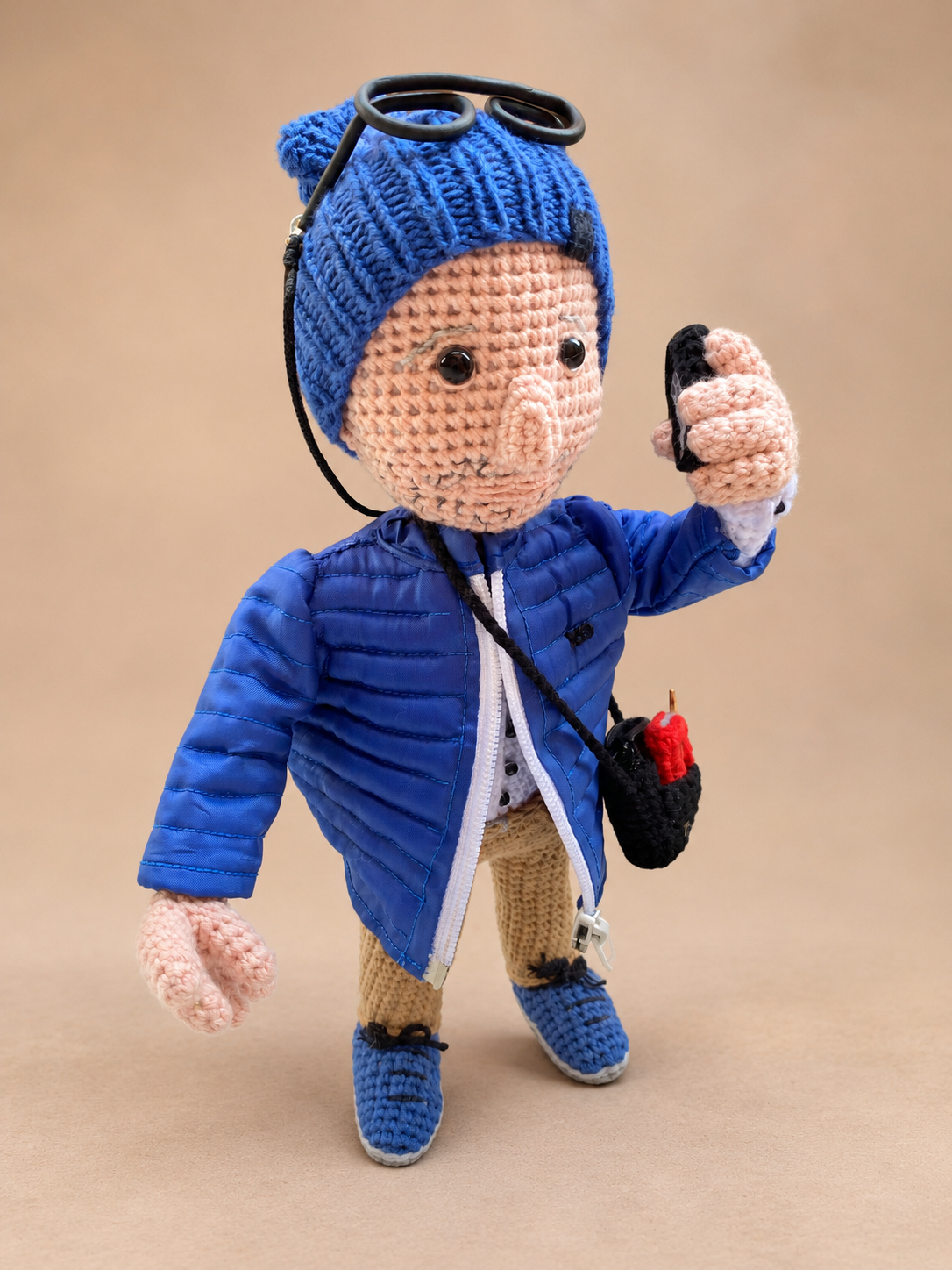
The finished crochet figure, shown with a digitally simplified background. Its phone and specially made jacket came from the customer's description of the recipient.
The customer later told us that people who saw the finished figure noticed the hours of work and the care in its details. They said it was well liked and that some viewers wanted to order a figure for someone close to them. This is the customer's account of the response, not a claim that the same reaction is guaranteed for every gift.
That project illustrates our usual starting point for custom work: customers can send photos and tell us which details matter to them. We also ask them to state hair and eye colors in words so we can choose yarn with those details in mind. The useful question is not “How many details can we add?” but “Which details would this person recognize as their own?”
If you are considering this route, our guide to ordering a custom crochet figure from a photo explains how to prepare the details.
4. Choose the form that suits the relationship
The same gift may feel different depending on who gives it. A close friend may know enough to recreate a beloved outfit or inside joke. A colleague may be better placed to give something modest and easy to accept. If the person has made a clear request, that request can be more reliable than either kind of guess.
You can make a simple gift more meaningful with a short, honest note: “You mentioned this book when we talked last month, and I remembered.” There is no need to invent a grand story. The note tells the recipient why you chose this thing for them.
5. Check timing and leave room for choice
Before ordering, check whether the gift can realistically arrive for the occasion. This matters especially for made to order pieces and international delivery. Look at the current product page and delivery estimate for the recipient's location; an estimate is not a guarantee. If time is short, a note or a plan to choose something together can be better than rushing into a poor fit.
If you are still unsure, ask a small question, offer two possible directions, or give the person a choice. A meaningful gift does not require mind reading.
A final three question check
- What real clue connects this gift to the person? A request, habit, interest or shared memory is stronger than a generic category.
- Will it fit their life? Consider where it will go, how they will use it, and whether they would want to keep it.
- Can you explain your choice in one honest sentence? If you can, that sentence may also be the note that goes with it.
If you cannot answer yet, pause and ask. That is part of choosing thoughtfully. For a gift note, one honest sentence is enough: “You mentioned this when we talked, and I remembered.”
When a handmade figure is the right gift
A custom figure is most fitting when the recipient enjoys keepsakes or display pieces and there is a person, character or detail they would be happy to see represented. Our work can include clothing and accessories chosen around a customer's brief. It is one possible answer, not the answer for everyone.
If the person would rather receive a requested book, a practical tool, or time together, choose that. A meaningful gift begins with their preferences. If a handmade figure does fit, you can see our current work on Etsy and check the available options and delivery details there.
If you are curious about the wider role of craft and care in a gift, read why handmade gifts can feel meaningful. This guide is about choosing for one person; that article explores the work behind a handmade piece.